
'Intrusions by PLA troops in the Ladakh sector are more in number than elsewhere and this region is now likely to remain an area of enhanced Chinese interest,' warns China expert Jayadeva Ranade.

A fleet of eight JF-17 Thunder fighter jets -- jointly made by the two countries -- will escort the Chinese president once his plane enters the Pakistani airspace.
'The Indian government wakes up after the fact when it can do nothing, or rather lacks the will to prosecute military actions to reverse these adverse PLA-driven developments.'

China has chosen to keep New Delhi guessing, while retaining for itself the option of constantly changing facts on the ground and shifting the LAC westwards -- the strategy called 'salami slicing', notes Ajai Shukla.

'Chinese troops are not geared to fight Indian troops who are battle hardened and acclimatised and are far more hardy.'
Within the army, there is growing concern that New Delhi will allow the Chinese to retain the territory they have occupied in the last month.

With the two armies again in a face-off at multiple points, there is apprehension of renewed clashes.

'This was Indian land the PLA advanced on and occupied.' 'The Chinese then 'negotiated' a pullback of their troops a small distance on Indian territory even as Indian jawans draw back further into India from the forward position.' 'An apparently satisfied Indian government says this is a great move for peace! How great is that for China!'
'India needs to learn in Kashmir how to spread development.' 'Pakistan needs to learn in Balochistan how to spread development.' 'China needs to learn in Xinjiang and Tibet.' 'And if they can show tangible benefits, there will be less terrorism.' 'No one wakes up in the morning saying 'I want to kill myself', right?'

Brushing aside India's concerns, China on Monday cemented its "all-weather ties" with Pakistan by agreeing to build a strategic $46 billion (Rs 2.9 lakh crore) economic corridor through Pakistan-occupied Kashmir as part of 51 deals signed, expanding the communist giant's influence in the region.

'The Indian side has realised that not talking to Pakistan has not served any useful purpose.'

'The MEA, hopefully, made it clear that the Indian PM can't be seen in Xi Jinping's company when China has, for all intents and purposes, annexed over 1,000 sq kms of Indian territory in eastern Ladakh, and essentially that the Wuhan spirit and the Mamallapuram spirit have turned into vinegar.'
'The one aspect which no Indian military thinker would wish to see emerge is a LoC type of posture at the LAC.' 'The LoC is manned for 750 km and terrorist infiltration has led to the creation of a virtual fortress along its entire length.' 'Something mirroring this at the LAC is going to be expensive although deployment everywhere is not warranted there.' 'However, given the complete trust deficit, there appear few alternatives,' notes Lieutenant General Syed Ata Hasnain (retd).
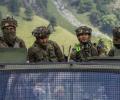
Today, the Ladakhis and Tibetans have been joined by the Sikhs, the Madrassis, the Garhwalis, the Rajputs, who are well trained psychologically and otherwise, to defend the nation, observes Claude Arpi.

The decision to not attend the forum attended by 28 heads of state and 130 national delegations is a clear break from its usual policy of going along with the crowd.
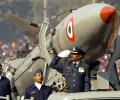
While we have to hiss loudly and do the lunging bit to keep our foes on their toes, that's only a tactical matter. What is the strategic goal? What is the end game? In my opinion, there is only one possible end game: the unwinding of Pakistan into several pieces: Balochistan, Sind, Balawaristan (Gilgit, Baltistan, the rest of PoK), the Pashtun area Khyber Pakhtunwa which will merge with Afghanistan, and the rump Punjab, says Rajeev Srinivasan.
'The Chinese have been moving in step by step; inch by inch for the last 40 years.'
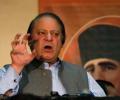
The Sino-Pakistan relationship remains fundamentally asymmetrical: Pakistan wants more out of its ties with China than China is willing to offer. Today, when Pakistan's domestic problems are gargantuan, China would be very cautious in involving itself even more, says Harsh V Pant.

When China protested strongly over the August decision on J&K -- not once but twice -- we ignored it. And to compound matters, we simply turned our back and walked over to the 'Quad' alliance with the US, upgrading it to ministerial level, and thereafter began following the American footfalls on Taiwan and COVID-19 to taunt and humiliate Beijing, observes Ambassador M K Bhadrakumar.

The government must figure out what the Chinese game plan is and thwart the endgame before it is upon us, possibly in early winter, advises David Devadas.

The developments in Af-Pak region, particularly the fall out of Pak political paralysis, would make President Xi Jinping's task a little more complicated, says Colonel R Hariharan.
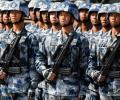
With the Indian Army having blocked the PLA several kilometres inside India, hundreds of soldiers from both sides remain in a tense face-off.
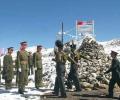
'We will not accept these misadventures by the Chinese.'
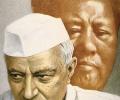
'Delhi was not concerned.' 'It would continue sleeping for several more years, with the result that Indian territory is still occupied by China today,' says Claude Arpi.

'Chinese leaders rarely receive their foreign guests in cities other than Beijing. Such respect for India!' 'Does it mean that Modi could replicate "the warmth and unconventional way" by sending Indian troops into Tibet, as Xi did in Chumur (Ladakh) when he arrived in India? Of course, Indians are far too polite to do so,' says Claude Arpi.

'India in 2020 is a lot better prepared than in 1962.' 'It is no longer a pushover; and anything other than a crushing Chinese military victory will be a major loss of face for China,' observes Rajeev Srinivasan in the first of a three part column.
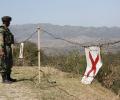
'The response to terror is not always reciprocal terror, nor is launching a conventional response the best response.' 'The best response is to make the sponsor pay a price he cannot afford,' says former RA&W chief Vikram Sood.

China is spending billions of dollars to improve infrastructure in Tibet and other parts of its border with India. Claude Arpi explains why New Delhi can't afford to ignore Beijing's plans.

Four major political takeaways from Narendra Modi's much-anticipated trip to China
